
Where Bellingham Previous Residents Appear
Bellingham address history is spread across county title records, library shelves, state archives, maps, newspapers, and city permit files. The best starting source depends on the date. Recent work can begin with a parcel number, while an early address may require a former town name and an in-person index. This era guide shows both the value and the limit of each source.
| Source | Years It Covers | Where Held | What It Shows |
|---|---|---|---|
| Auditor recorded documents | 1920 to present online; 1853-1997 microfilm access | Whatcom County Auditor | Named parties, document date and type; parcel and legal keys after 1997 |
| Reverse Polk directories | Beginning in 1931 | Bellingham Public Library | People listed under a street address in a dated edition |
| Polk city directories | 1890 and 1899 to date at BPL; State Library years have gaps | BPL and Washington State Library | Names, spouses, occupations, businesses, and street addresses |
| Census collections | 1885 territorial census and released federal schedules | Washington Digital Archives and library databases | Household members and demographic or work categories at one census date |
| City permits | 1997 to present, subject to city and record limits | Bellingham eTRAKiT | Address, applicant role, permit type, status, dates, and some documents |
For a recent transfer, begin with the assessor and Auditor. For past residents after 1931, the reverse directory is often faster than a name search. Earlier Bellingham research should also test Fairhaven, Sehome, Whatcom, and New Whatcom, because the modern city name does not cover every historical label.
Anchor Bellingham Previous Residents to a Parcel
The Whatcom County Real Property Search accepts a street number and name, owner, city, Property ID, or parcel/Geo ID. Save the situs address, owner-of-record, mailing address, abbreviated legal description, parcel ID, subdivision, and map references. The portal distinguishes mailing and situs addresses, an important warning against treating a tax mailing address as proof of occupancy.
| Field | Use in a backward search | What not to assume |
|---|---|---|
| Parcel/Geo ID | Stable join key across assessor, maps, and post-1997 recording searches | It does not name every resident |
| Legal description | Connects deeds despite street renaming or number changes | It is not a plain-language boundary survey |
| Owner and mailing address | Starting point for the newest transfer | Owner and addressee may live elsewhere |
| Neighborhood and map ID | Locates the parcel in present map layers | Modern labels may not fit an older record |
Capture the tax year and retrieval date because current fields change. If the address will not resolve, use a partial street entry, the legal-location fields, or the county map to recover the parcel key.
Trace Bellingham Past Residents Through Deeds
The Whatcom County Digital Research Room indexes instruments by names in the document, Auditor file number, document date, and document type. Parcel number and legal description become search keys for records after January 1, 1997. Online indexes and images are described as covering 1920 forward, while the Auditor public research area provides 1853-1997 microfilm. The online material is unofficial, may contain errors, and has Social Security numbers redacted.
- Copy the current owner, parcel number, and legal description from the assessor card.
- Find that owner's acquisition instrument and record its grantor, grantee, date, type, and Auditor file number.
- Search the seller as an earlier grantee, then compare the legal description before joining the records.
- Repeat the link backward, noting gaps, transfers involving estates, and any change in the parcel description.
- For older material that the web index does not expose, use the Auditor microfilm research area or an assisted request.
- Grantor and grantee
- The grantor transfers an interest; the grantee receives it. The role can change for the same person from one deed to the next.
- Chain of title
- The linked sequence of instruments through which an interest in the parcel passed over time.
- Legal description
- The recorded land description used to identify property even when its street address or town label changes.
Find Older Records for Bellingham Previous Residents
A negative online search does not close the Bellingham trail. Older research may require microfilm in the Auditor's public research area, an assisted search, or a copy request. The recorded-document copy page explains phone, mail, and office routes, as well as ordinary and certified copies. Supply the Auditor file number when known. Otherwise give the names, date range, document type, parcel number, and legal description.
Note. Inspection, copying, certification, postage, and staff research are separate services, so check the current county schedule before ordering.
If a missing item is held by another department, use that custodian. Washington's Public Records Act covers existing agency records, but the agency need not create a new list of everyone who lived at an address. A focused request for a named record series and date range is more reproducible.
Map Former Homes of Bellingham Past Residents
Bellingham formed from Whatcom, Sehome, Bellingham, and Fairhaven, so pre-consolidation names deserve separate searches. CityIQ historical layers include historic towns, streets, districts, shoreline, annexations, parcels, and donation land claims. County landbase layers add parcel history, subdivisions, easements, plats, vacations, and tax parcels. These layers explain mismatches, but recorded deeds and plats control legal descriptions.
The strongest map stack combines different questions: a 1904 Sanborn sheet shows the structure and its block, a 1905 Polk edition can supply a listed person, a recorded instrument documents a legal transaction, and a current parcel report fixes the modern location. The Library of Congress set has 83 Bellingham, Fairhaven, and Sehome sheets. It can show footprints, use, materials, openings, and fire notation, not the identity of a resident.
Research Bellingham Past Residents at the Library
The Bellingham Public Library property guide brings together Polk directories, the reverse-address index, Sanborn maps, newspaper tools, and a partial index to the Bellingham Herald's Beautiful Home Series. That series ran from October 27, 1906 through November 16, 1907 and can add owners, occupants, architecture, and address clues, though it is not a complete roster.
The library's local property information page shows how these address sources are organized.
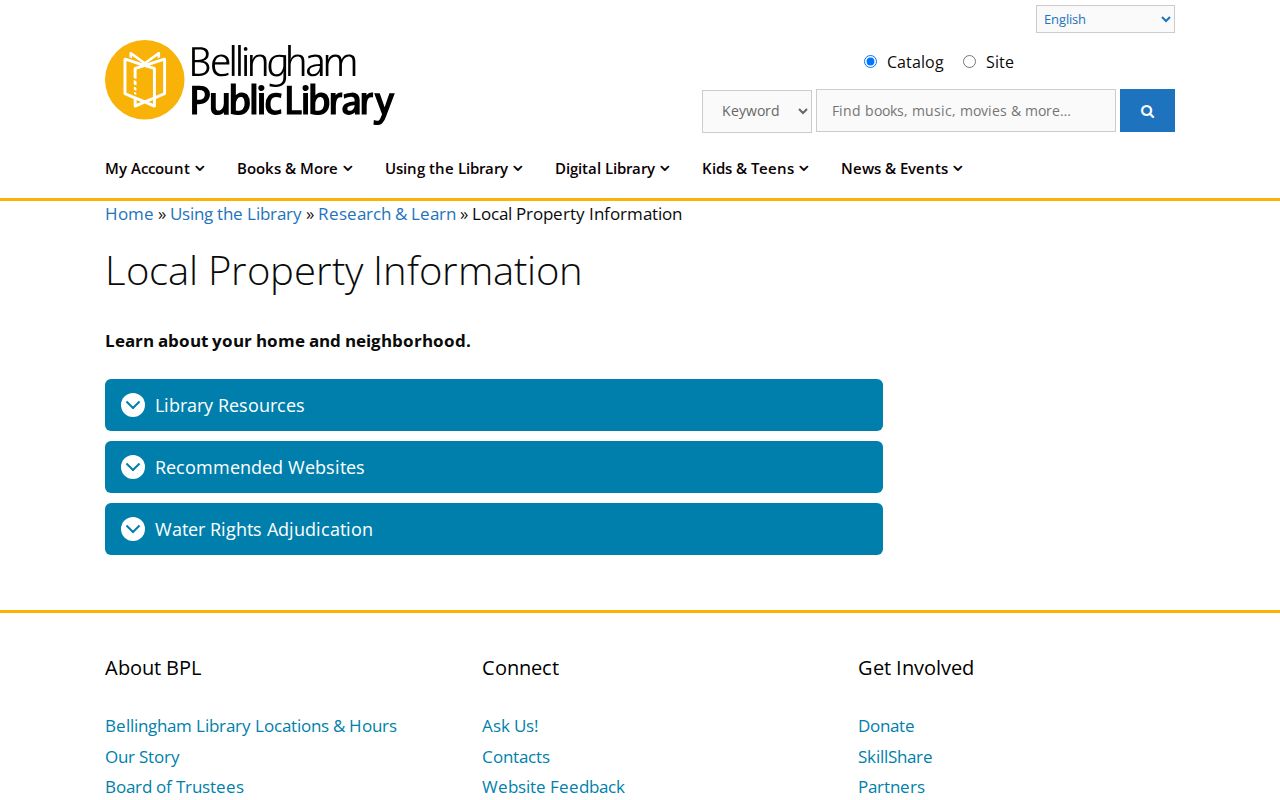
This page is a practical bridge from a modern address to directories, maps, newspapers, and reference-desk help.
Central Library at 210 Central Avenue offers local-history and microfilm support, with the house-history guide listing the Reference Desk at 360-778-7323. Some databases require a library card or in-library use. Search the address in the partial index, verify the article on microfilm, and record the publication date. For photos and maps, Whatcom Museum's research room and searchable PastPerfect catalog provide another channel, while Western Washington University and Northwest Regional Archives hold regional and government collections.
Use Permits to Date Bellingham Previous Residents
City eTRAKiT reports permit activity from 1997 forward, within city and record-type limits. A public result may show the address, permit or project number, record type, applicant, contractor or license, dates, status, inspections, and available documents. These entries help date work on a building, but an applicant or contractor is not automatically one of its previous residents.
County permit history uses the Customer Service Portal, with searches by case number, address, date, project name, inspections, and map. Records from before February 2022 may look incomplete or different because of migration. Note the exact role attached to a person and compare the permit date with a directory, deed, or census entry before drawing a connection.
Pair Sources for Bellingham Previous Residents
Ownership is only one layer. BPL's reverse cross-index begins in 1931 and can reveal who was listed at the address in a specific edition. Its Polk holdings begin with 1890 and 1899 to date; the State Library's Bellingham list runs through 2013 with many missing years. Treat a gap as an unavailable edition, not proof that past residents left. The collections themselves are detailed on the Bellingham city directory page.
- Choose the closest available directory before a released census year and transcribe the address exactly.
- Search the census with name and town variants, then inspect nearby households and the original page.
- Check the next available directory for spouse, occupation, street, and town-label changes.
- Repeat around each transfer date in the deed chain and mark every source as a dated snapshot.
For the end of a household trail, use State Archives Whatcom death records for 1891-1907, BPL Herald microfilm, local notices, probate routes, and Bayview Cemetery staff. No official public Bayview interment database was located, so contact the cemetery for a plot inquiry. An obituary can name relatives, former addresses, or organizations, but its family-submitted details need corroboration.
Lawful use. Research previous residents for house history, genealogy, estate work, or personal curiosity. Do not expose protected addresses or use a historical trail to watch, harass, intimidate, or harm a living person.